Tag: Invega Sustenna

  • Gov. Whitmer and President Grasso: Evidence Too Serious for Silence—Michigan Must Investigate Cassandra Fameux Case

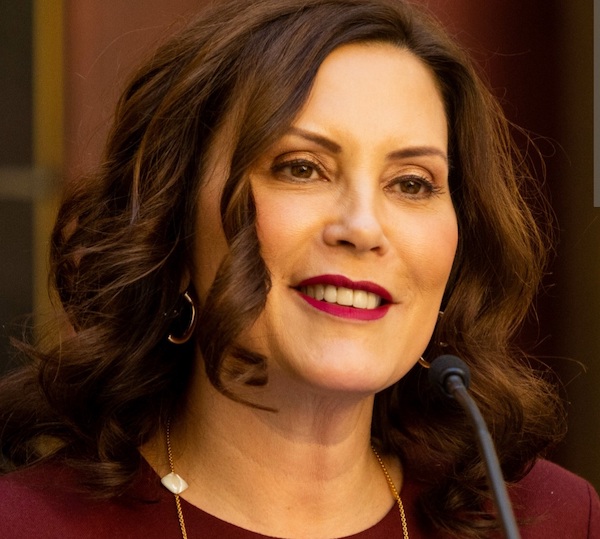
    Gov. Whitmer could learn something from New York’s Hochul. Photo: Wikimedia commons.

    Police investigated and recommended a criminal charge.

    A state regulatory agency reportedly determined that medical records had been altered and described the conduct as criminal. The University of Michigan fired Dr. Paul St. Claire under a nondisclosure agreement (NDA). St. Claire himself testified that the University told him his termination involved a “HIPAA violation.”

    How much more must surface before Michigan demands the truth?

    The Cassandra Fameux case has reached the point where silence by Michigan’s most powerful public officials and institutions is increasingly difficult to explain.

    Black Star News therefore renews its call to Governor Gretchen Whitmer, Attorney General Dana Nessel, University of Michigan President Domenico Grasso, and the University’s Board of Regents: Do the right thing.

    Governor Whitmer should use whatever lawful authority is available to ensure an independent investigation into what happened to Cassandra Fameux, including the conduct of her now ex-husband, Dr. Paul Gregory St. Claire; psychiatrist Dr. Dominic Barberio; University of Michigan Health-Sparrow; and the responses of the institutions that subsequently encountered these allegations.

    The University of Michigan should disclose why St. Claire was terminated and explain the circumstances surrounding the nondisclosure agreement executed when his employment ended on February 28, 2024. It should also explain why it never terminated him after substantiating multiple sexual harassment allegations.
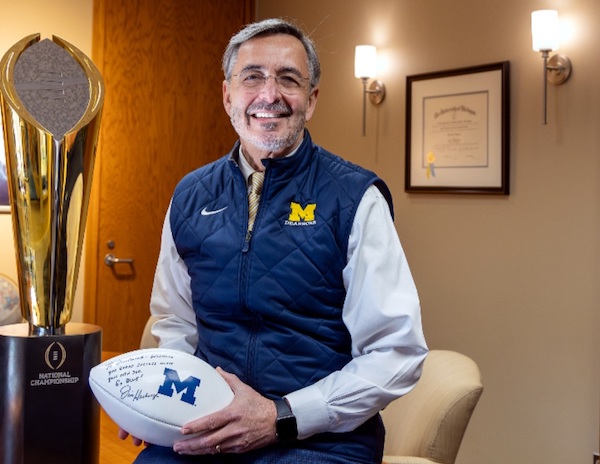
    We know his priorities. After firing coach Sherrone Moore for having an affair with a subordinate, President Grasso paid million of dollars to an outside firm to investigate the football program. He’s mute on Fameux. Photo: Wikimedia commons.

    This is no longer simply Fameux’s word against her former husband’s. There is a police investigation. There are regulatory records. There are sworn depositions. There are medical records. There is an NDA.

    And there are extraordinary contradictions demanding answers. Fameux alleges that St. Claire, an anesthesiologist formerly employed by University of Michigan Health-Sparrow, and psychiatrist Dr. Dominic Barberio “poisoned” her with powerful antipsychotic medications from 2014 through 2023, even though she—and subsequently several psychiatrists—maintained that she did not suffer from schizophrenia or bipolar disorder.

    Meridian Township Police investigated Fameux’s complaint for approximately six months. On April 10, 2025, the police report signed by Detective Ian Mandernack concluded: “Forward to the Ingham County Prosecutors Office seeking a charge of domestic assault against Paul Gregory StClaire.”

    The prosecutor declined to authorize charges. The controversy surrounding Jane Doe’s allegations at Cornell University has reminded Americans of an important lesson: A prosecutor’s decision not to prosecute does not mean that every legitimate question has been answered—particularly when allegations intersect with powerful institutions such as Cornell University and the University of Michigan.

    There is another document Michigan officials cannot responsibly ignore.

    Community Mental Health (CMH) social worker Linda Wenzel memorialized information she reported receiving from the Michigan Department of Licensing and Regulatory Affairs (LARA) in July 2024. According to Wenzel’s note, LARA reported that Fameux’s estranged husband “did in fact access and modify” her records, described the conduct as “criminal” in nature, and recommended that Fameux file a police report and obtain a personal protection order (PPO).

    Wenzel subsequently accompanied Fameux when she filed her September 10, 2024 complaint with Meridian Township Police in Okemos, Michigan, leading to the recommendation that a criminal charge be filed against St. Claire.

    Separately, in May 2024, LARA spokesperson Abby Rubley told Black Star News that the department did not comment on “open investigations.”

    Investigator Norm Naimy later confirmed to this newspaper in November 2024 that an investigation remained active. So what did LARA ultimately determine? LARA Director Marlon I. Brown, a Whitmer appointee, has not responded to Black Star News inquiries. The public has a right to know. If the agency found alleged “criminal” behavior and as memorialized by Wenzel, why does St. Claire still hold a medical license? 

    When University of Michigan Health-Sparrow terminated St. Claire on February 28, 2024, why did it enter into a nondisclosure agreement with him?

    That question has become far more important because of St. Claire’s own sworn testimony and the police recommendation of a criminal charge.

    During his September 25, 2024 divorce deposition, Fameux’s attorney, Timothy Young, questioned St. Claire about whether there was evidence in his Sparrow employment record establishing that Black Star News reporting had caused his termination.

    St. Claire responded: “Yeah, I’m not privy to that other than—all I know is they said HIPAA violation. Your wife states that.”
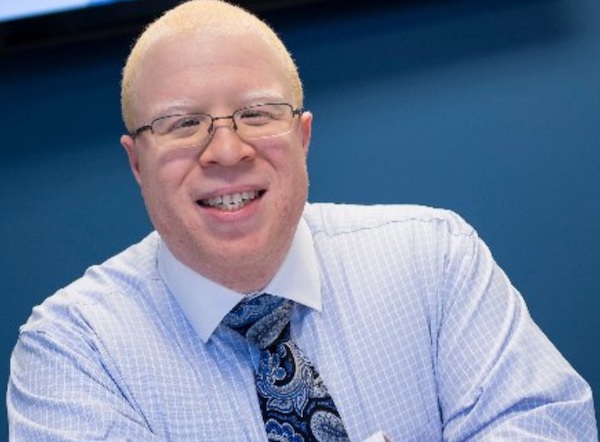
    LARA Director Brown. If his agency told Ms. Wenzel that Dr. St. Claire altered his wife’s medical record and that it was “criminal” in nature why does he still hold a medical license?

    Yet St. Claire, in what Black Star News considers an ongoing campaign to muzzle investigative journalism, sued the newspaper, its publisher Milton Allimadi, and Fameux for defamation in July 2024, claiming, among other things, that the reporting damaged his reputation and employment.

    Two years later, in July 2026, after Black Star News served interrogatory responses 48 hours late, St. Claire obtained a default and a multimillion-dollar jury award from a Michigan court. The 48 hours delay occurred after Allimadi discovered that years’ worth of email messages exchanged with St. Claire’s lawyers had been deleted in an apparent hacking incident, necessitating many hours of searches and causing delays. The incident was reported to the FBI and NYPD.

    Allimadi has already moved to set aside the default and resulting judgment.

    The timing of St. Claire’s 2024 lawsuit also deserves scrutiny.

    According to Wenzel’s contemporaneous note, July 2024 was the same month LARA informed her that St. Claire had accessed and modified Fameux’s records and characterized the conduct as criminal.

    Was the timing of the lawsuit coincidental? The first Black Star News article detailing Fameux’s allegations was in December 2023 and St. Claire did not sue until seven months later. That is precisely why Michigan needs an independent investigation rather than assumptions.

    Here are questions for President Grasso and the University of Michigan:

    What was the HIPAA violation to which St. Claire testified? Did it involve Cassandra Fameux? Did it involve access to or alteration of her medical records? Why did the University execute an NDA with St. Claire when it terminated him?

    Fameux alleges that she received Invega Sustenna injections between approximately 2017 and 2021 without a legitimate schizophrenia diagnosis. She maintains that no valid prescription supported the years-long course of injections.

    In fact, on December 16, 2014, around the time Fameux alleges that St. Claire and Barberio began “poisoning” her with antipsychotic medications, Dr. John Maino documented the following diagnoses: anorexia; depression; anxiety; anxiety attacks; insomnia; and microcytic hypochromic anemia.

    There was no mention of schizophrenia or bipolar disorder.

    In divorce testimony, St. Claire characterized his administration of the injections as occurring only “occasionally.”

    Yet, in his February 7, 2025 deposition, Barberio testified that St. Claire personally administered approximately 90 percent of Fameux’s Invega Sustenna injections, while Barberio’s nurses administered approximately 10 percent in his office.

    Detective Mandernack’s police report states that Barberio produced documentation for only one prescription despite nearly four years of injections.

    Fameux also provided police with a secretly recorded September 2023 conversation in which Barberio acknowledged that she was not schizophrenic.

    Invega Sustenna is a powerful antipsychotic medication with potentially serious adverse effects. Fameux attributes several serious medical conditions to the years of injections: a brain tumor; a heart condition requiring implantation of a loop monitor in her chest; diabetes; and infertility following surgery to stop excessive menstrual bleeding. These alleged causal connections require independent medical examination.

    Then there is the 2018 Judgment of Separate Maintenance (JOSM), which Fameux and her divorce attorney, Timothy Young, said she signed while under the influence of antipsychotic medications. Fameux signed the agreement on February 20, 2018, transferring 100 percent of the marital assets—millions of dollars and two homes—to St. Claire.

    St. Claire had successfully moved the Ingham County Circuit Court to declare Fameux legally incompetent in 2015. Yet the court never appointed a guardian ad litem (GAL) for Fameux before she signed the JOSM, Black Star News reported. Black Star News also reported in November 2025 allegations that St. Claire, his divorce attorney Jessica Larson, and Judge Carol Koenig, who presided over the case, participated in fabricating the existence of a GAL. The alleged fabrication helped sustain the JOSM, according to the reporting.

    These allegations concern proceedings in the same Lansing, Michigan, court system where St. Claire’s defamation case is being heard. They warrant independent examination.

    Six months after that reporting, Larson departed her law firm, and shortly thereafter, the firm, Mallory Lapka Scott Selin, apparently shut down.

    Fameux’s attorney, Timothy A. Deimer of Jacobs and Deimer, has filed an appeal asking for the JOSM to be set-aside. 

    Yet the JOSM remains in effect. Fameux says she has been left largely dependent on retirement funds and without health insurance, preventing her from having her brain tumor regularly monitored.

    St. Claire, in his defamation case, claims that Black Star News reporting was based on Fameux’s “delusions.”

    In a July 22, 2026 Facebook posting attacking Black Star News and Allimadi, St. Claire’s attorney, C. Christopher Newberg, characterized the journalism as a “relentless, vindictive, and malicious online smear campaign” and a “delusional web of heinous, fabricated criminal accusations.” He also referred to supposedly “bizarre” and “fictional” claims.

    Yet during St. Claire’s 2003 divorce proceedings, attorney Nan Elizabeth Casey, representing his late second wife, Dr. Marcy Street, stated that evidence would be introduced that St. Claire had previously spent more than three weeks in a mental-health institution.

    During that same divorce from Dr. Street—whom St. Claire also accused of mental illness, although he qualified that characterization in a 2024 divorce deposition by saying she was not “crazy crazy” like Fameux—the couple’s household employee, Shelley Van Epps, filed a sworn affidavit dated December 4, 2003, containing disturbing allegations.

    Van Epps alleged that on November 13, at 11 am, she found St. Claire eating cat food while drinking wine. She claimed that St. Claire told her “he was horny” and asked whether she was horny, too. She alleged that he asked whether her husband “rubbed her clitoris.”

    She further alleged that St. Claire asked whether she believed her husband would “kill her and her children.” Van Epps concluded her affidavit: “I was frightened by his behavior which I found bizarre and unexplainable… That I called Dr. Street and explained what had happened for reason that I was fearful of his behavior and afraid for Dr. Street and her children.”
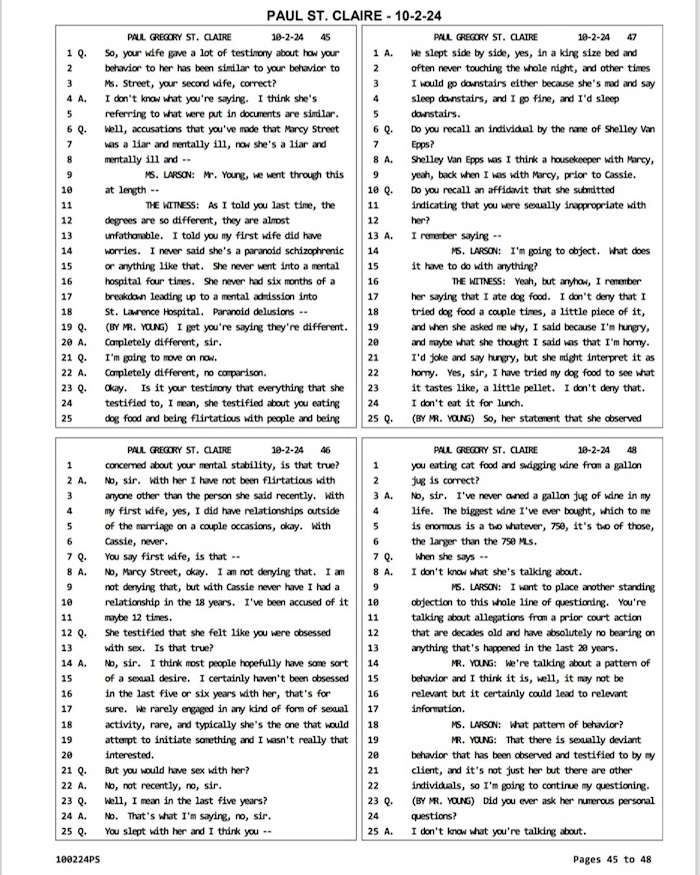
    In October 2, 2024 divorce deposition Dr. St. Claire seemed to deny eating cat food, but conceded that he ate dog food although he didn’t “eat it for lunch.” Page 27, deposition transcript.

    Black Star News does not present these allegations as a psychiatric diagnosis or as proof of any medical condition.

    Years later, on October 2, 2024, during his divorce deposition, Fameux’s attorney, Young, questioned St. Claire about Van Epps’ allegations. According to the deposition transcript page 47, St. Claire responded: “Yeah, but anyhow, I remember her saying that I ate dog food. I don’t deny that I tried dog food a couple times, a little piece of it, and when she asked me why, I said because I’m hungry, and maybe what she thought I said was that ‘I’m horny.’ I’d joke and say ‘hungry,’ but she might interpret it as ‘horny.’ Yes, sir, I have tried my dog food to see what it tastes like, a little pellet. I don’t deny that. I don’t eat it for lunch.”

    That testimony speaks for itself. Black Star News does not need to embellish it.

    If St. Claire’s attorney wants the public to judge Allimadi’s journalism by tossing around words like “delusional” and “bizarre,” and if St. Claire continues invoking Fameux’s alleged mental illness to undermine her credibility, then the public deserves to know that court records contain allegations and testimony concerning St. Claire himself that might readily have been subjected to the same kind of irresponsible rhetoric.

    The point is not to diagnose St. Claire. It is to expose the glaring double standard in the use of psychiatric labels to discredit a Haitian immigrant woman whose allegations have generated a police investigation, a recommendation for criminal charge, regulatory scrutiny, and substantial sworn testimony.

    The ball is now in Governor Whitmer’s and University of Michigan President Grasso’s court. Perhaps both hoped St. Claire’s defamation case would distract attention from the Fameux case and what happened to her.

    If so, they miscalculated. The Cornell case has redirected national attention toward the accountability of powerful universities and the institutions charged with investigating allegations against people associated with them.

    Michigan cannot credibly demand accountability elsewhere while refusing to confront the troubling questions arising within its own institutions.

    The police investigated. The police recommended a criminal charge. A state regulatory agency reportedly identified potentially criminal conduct involving medical records. The University terminated St. Claire under an NDA. And St. Claire’s own sworn testimony raises questions about the reason for his dismissal.

    How much more evidence must emerge before Michigan’s leaders act?

    In Michigan, the chickens have come home to roost.

    Governor Whitmer and President Grasso—Do the right thing. 

    Note: Justice for Cassandra Petition

  • St. Claire Defamation Case: Jury Should Decide Not a Procedural Technicality

    Among the many claims in Dr. St. Claire’s defamation lawsuit against Black Star News and me is that I falsely reported that he was being investigated by Meridian Township Police in Okemos, MI, based on allegations by his wife Cassandra Fameux that he posioned her for nine years with antipsychotic drugs. That investigation led to a recommendaiton by police that he be criminally prosecuted, even though the DA declined. Dr. St. Claire also claimed I defamed him by falsely reporting that he was having an affair with a married nurse at the University of Michigan Health Sparrow during the period his wife told police he and Dr. Dominic Barberio were drugging her. This is the video evidence I provided my lawyers in my answer to Dr. St. Claire’s amended complaint.

    By Milton Allimadi

    When the Ingham County 30th Judicial Circuit Court in Lansing, Michigan, scheduled a July 20, 2026 jury trial before Judge Morgan Cole in Dr. Paul Gregory St. Claire’s defamation lawsuit against me and Black Star News, I welcomed the opportunity. 

    After nearly two years of litigation, I was finally going to present the evidence behind my reporting before a jury.

    That is how defamation cases should be decided. A jury should hear the evidence, examine the documents, assess the credibility of witnesses, and determine whether a journalist acted responsibly. I have never feared that process because I know the reporting I published was grounded in evidence.

    Today, however, that opportunity is in jeopardy. 

    The court has granted Dr. St. Claire’s motion for a default judgment after my discovery responses were submitted two days after the court’s deadline, June 26, 2026 instead of June 24. 

    I have retained new counsel to deal with this matter because I believe this case deserves to be decided on its merits—not on a procedural technicality. The public should understand what is at stake and the importance of the First Amendment.

    From the beginning, my reporting was based on allegations made by Cassandra Fameux, Dr. St. Claire’s former Haitian immigrant wife, who alleged that she was administered antipsychotic medications from 2014 through 2023 despite not suffering from schizophrenia or bipolar disorder. (From 2014 to 2017 she was allegedly drugged with Risperdal; 2017 to 2021 with Invega Sustenna; and 2021 to 2023 Abilify). 

    Those allegations were not published in isolation. They were investigated, documented, and supported by medical records, court filings, interviews, and later by a police investigation.

    Ms. Fameux alleged that Dr. St. Claire’s colleague at the University of Michigan Health Sparrow psychiatrist Dr. Dominic Barberio misdiagnosed her as schizophrenic with bipolar disorder in 2014. Prior to that, medical records show that on December 16, 2014  another physician at the same hospital, Dr. John Maino, had diagnosed Ms. Fameux with anorexia, depression, anxiety attacks, insomnia, and microcytic anemia. There was no mention of schizophrenia or bipolar disorder. 

    Ms. Fameux claimed for most of the years when she was injected with Invega Sustenna, no prescription was written and that the drug was retrieved from a storage cabinet in Dr. Barberio’s office. When police later interviewed Dr. Barberio he printed out only a summary of one visit showing that a presciption was written; that date was November 6, 2020, according to the police report. Yet, Ms. Fameux told police she was injected from 2017 to 2021.

    Dr. St. Claire was terminated by the University of Michigan Health Sparrow on February 28, 2024. The hospital and Dr. St. Claire executed a non-disclosure agreement (NDA) according to his divorce court testimony. 

    The Meridian Township Police Department investigated the same allegations that Dr. St. Claire claims were defamatory. On April 10, 2025, Det. Ian Mandernack recommended criminal domestic assault charges. 

    Ms. Fameux told police the side effects of the Invega Sustenna gave her a brain tumor, diabetes, a heart condition, and other ailments. “Cassandra advised that the continuous Invega injections is the reason the tumor and diabetes developed,” Officer Nathan Wicks of the Meridian Police Department wrote in the police report. “Cassandra had medical paperwork proving her claims.” 

    Ms. Fameux told Officer Wicks that the only time that Dr. Barberio himself ever injected her was when her husband was angry at her and phoned him to come to the marital home to inject her with Invega Sustenna as “punishment.” (Dr. Barberio and Dr. St. Claire denied any injection at home was to punish Ms. Fameux. Dr. St. Claire kept hand-written notes of a home visit on May 27, 2020 by Dr. Barberio).

    Although the Ingham County Prosecutor ultimately declined to authorize criminal charges, I published the complete police report at the end of the article so readers could evaluate the evidence for themselves.

    Ms. Fameux alleged Dr. St. Claire’s motive was to coerce her into signing a Judgment of Separate Maintenance (JOSM) on February 20, 2018–while under the influence of the drugs——that transferred all marital assets and the couple’s two homes to Dr. St. Claire.

    I later reported and wrote an article on November 30, 2025 questioning the validity of the JOSM because the court had not appointed a Guardian Ad Litem for Ms. Fameux before she signed the agreement as required by law, having been declared incompetent in 2015. 

    I also reported on the apparent role played by divorce court judge Carol N. Koenig, Dr. St. Claire, and his divorce lawyer Jessica Larson in fabricating a GAL in order for Koenig to uphold the JOSM. 

    Judge Koenig, who handled the St. Claire’s divorce and apparently together with St. Claire and his divorce lawyer Ms. Larson fabricated a Guardian Ad Litem for Ms. Fameux.


    I reported on May 12, 2026 that Ms. Larson parted ways with her law firm Mallory Lapka Scott and Selin. 


    Then I  reported on May 23, 2026 that the entire firm shut down.

    My reporting also relied on court testimony.

    Three psychiatrists ultimately concluded that Ms. Fameux did not suffer from schizophrenia or bipolar disorder. One of them, Dr. Rita Aouad, testified during the divorce trial that Ms. Fameux suffered from severe PTSD resulting from what she described as an abusive marriage. In fact during divorce deposition Ms. Fameux’s lawyer Timothy Young asked Dr. St. Claire about his own reported mental health diagnosis and he refused to answer the question according to the transcripts. 

    Ms. Fameux also provided police with an audio recording she secretly made in September 2023 in which Dr. Dominic Barberio acknowledged that she was not schizophrenic. At trial, Dr. Barberio testified that he made those statements merely to “placate” her. That contradiction is part of the public court record.

    Additional testimony raised further questions.

    University of Michigan medical records that I reviewed identify Dr. Barberio as the physician administering Ms. Fameux’s monthly Invega Sustenna injections between 2017 and 2021. Yet during the divorce trial, Dr. Barberio testified that Dr. St. Claire personally administered approximately 90 percent of those injections while the remaining injections were given by his nursing staff.

    I filed a FOIA request with the University of Michigan Health Sparrow on October 15, 2025 and paid the requested $25 fee and still await for the information. The university has given me six dates over the past several months and when that date arrives it sets another future date.

    These are precisely the kinds of factual issues that juries are asked to evaluate.

    Dr. St. Claire’s complaint also alleges that I falsely reported he had an affair with a married University of Michigan nurse. Yet during his divorce testimony, Dr. St. Claire acknowledged that relationship. In addition, I reported that I reviewed video evidence supporting my reporting of the allegations and provided a copy to my lawyers as one of the exhibits in my answer to Dr. St. Claire’s amended complaint.

    Dr. St. Claire also claims I falsely reported that he was under police investigation. The police investigation is not in dispute. It culminated in detectives recommending criminal charges on April 10, 2025, as already mentioned.

    Dr. St. Claire further alleges that I falsely reported an investigation by Michigan’s Department of Licensing and Regulatory Affairs (LARA). Yet a LARA investigator Norm Naimy interviewed me on October 4, 2024 during that investigation and said my reporting confirmed his findings, and Community Mental Health records document that Ms. Fameux’s social worker Linda Wenzel recorded information she said she received from LARA confirming that Dr. St. Claire altered Ms. Fameux’s medical records.

    Indeed, in his divorce testimony Dr. St. Claire himself said he was forced to resign because the hospital said his wife reported that he had accessed her medical records without permission. 

    This is why I have consistently maintained that a jury—not a procedural ruling—should evaluate my reporting and the evidence I included as exhibits in my answer.

    Separately, my discovery responses to interrogatory questions were submitted two days late under extraordinary circumstances. While preparing those responses, I discovered that years of Gmail correspondence with Jessica Larson, Dr. St. Claire’s divorce attorney, had disappeared from my account. Shortly thereafter, I discovered that my email correspondence with Dr. St. Claire’s attorney, Chris Newberg, had also been deleted.

    I immediately reported the apparent data breach to the FBI on June 22, 2026, later visited FBI headquarters in New York on June 26, 2026 to file additional information, and also reported the matter to the New York Police Department Commissioner Jessica Tisch on June 29, 2026. I informed my attorneys and asked that the court be advised because the missing emails directly affected my ability to prepare discovery responses. Despite those circumstances, I completed and submitted a 73-page response on June 26, 2026.

    One of the e-mails deleted was a letter I sent Dr. St. Claire’s defamation lawyer Newberg, on May 4, 2024—after I received his Demand Letter on May 1, 2024—in which I offered to interview Dr. St. Claire to give him an opportunity to set the record straight on the articles I had published. Newberg did not accept that offer but responded with litigation. 

    While Dr. St. Claire and Dr. Barberio maintained they medicated Ms. Fameux with antipsychotic drugs because she was schizophrenic and had bipolar disorder, as I also reported the court record from Dr. St. Claire’s 2003 divorce from his second wife, the late Dr. Marcy Street, also show that Nan Elizabeth Casey, the lawyer who represented Dr. Street raised questions about his own mental health.  

    During the 2003 divorce, attorney Casey, in court papers stated: “Testimony will also be presented showing that defendant St. Claire was in a mental institution for over three weeks some years ago. His behavior is not only bizarre but inappropriate.”

    The court record also includes a sworn affidavit dated December 4, 2003, from the couple’s housekeeper, Shelley Van Epps, describing what she characterized as “bizarre” and “frightening” behavior.

    According to the affidavit, on November 13, 2003, while working at the couple’s home, “Dr. St. Claire was eating cat food and swigging wine from a gallon jug. This occurred at approximately 11 a.m.” Ms. Van Epps further stated that Dr. St. Claire asked her numerous personal questions, including, “Does your husband rub your clitoris, I mean back?” She also alleged that he repeatedly told her he was “horny,” asked whether she was “horny,” and asked whether her husband would ever kill her and her children.

    She concluded her affidavit: “I was frightened by his behavior which I found bizarre and unexplainable… That I called Dr. Street and explained what had happened for reason that I was fearful of his behavior and afraid for Dr. Street and her children.”

    These are from court documents available to any journalist.

    Shelley van Epps affidavit.

    More than two decades later, during Dr. St. Claire’s October 2, 2024 deposition in his divorce from Cassandra Fameux, Ms. Fameux’s attorney, Timothy Young, questioned him about Ms. Van Epps’ affidavit.

    Over the objection of his attorney, Ms. Larson, Dr. St. Claire testified, according to the deposition transcript: “Yeah, but anyhow, I remember her saying that I ate dog food. I don’t deny that I tried dog food a couple times, a little piece of it, and when she asked me why, I said because I’m hungry, and maybe what she thought I said was that ‘I’m horny.’ I’d joke and say ‘hungry,’ but she might interpret it as ‘horny.’ Yes, sir, I have tried my dog food to see what it tastes like, a little pellet. I don’t deny that. I don’t eat it for lunch.” Ms. Van Epps’ December 4, 2003 affidavit did refer to cat food—not dog food.

    I remain confident that this case belongs before a jury.

    Journalists should be judged on the evidence supporting their reporting. In this case, that evidence includes medical records, police investigative findings, sworn testimony, audio recordings, court filings, and contemporaneous documents. I have always welcomed judicial scrutiny of that evidence because it demonstrates that my reporting was neither reckless nor fabricated.

    I intend to continue fighting to have this case heard on its merits.

    I understand that with the intervention of law enforcement agencies—such as the FBI or NYPD—or a court order, Google can actually recover e-mails that have been deleted and can also potential trace the source of the breach. The deleted information will assist in my defense and could also pave the way for criminal proceedings if those responsible can be identified. 

    To everyone who has followed my reporting since 2023, thank you for your support. I am asking for your continued help as I seek to overturn the default judgment and restore this case to a jury trial. Contributions to my legal defense fund will help cover appellate filings, legal representation, court costs, and travel expenses to Michigan associated with the litigation. Black Star News is based in New York City. 

    Independent investigative journalism depends not only on reporters willing to pursue difficult stories, but also on readers willing to defend the principle that truthful reporting should be tested by evidence—not silenced by procedural obstacles.